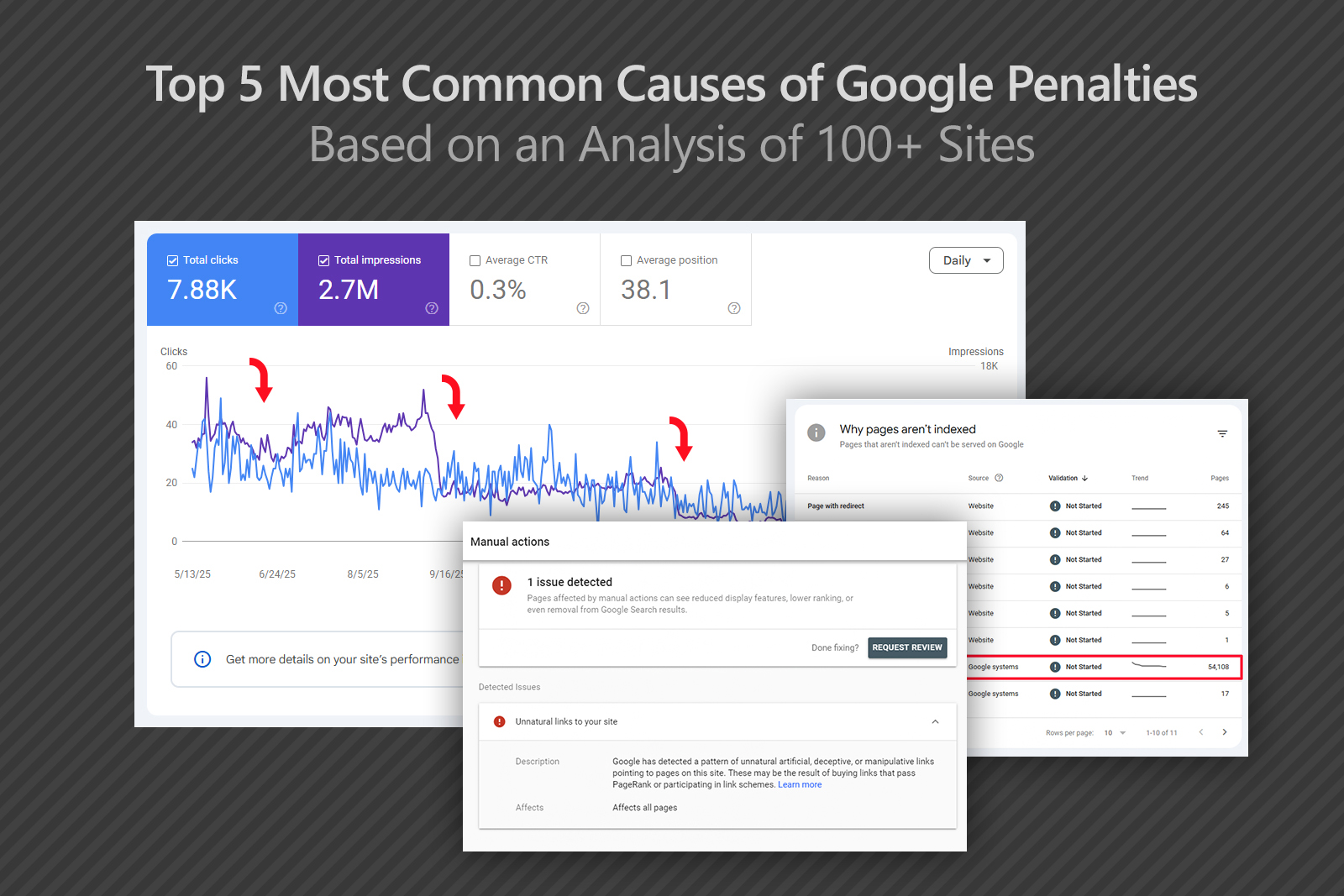
Top 5 Most Common Causes of Google Penalties Based on an Analysis of 100+ Sites

Top 5 Most Common Causes of Google Penalties Based on an Analysis of 100+ Sites

Over the past four years, we have analyzed more than 100 websites that came to us for recovery from Google manual actions and algorithmic penalties.

Based on this analysis, I have compiled the five most common causes of Google penalties. These are, in our experience, some of the most widespread issues we have encountered in recent years, and they can significantly increase the likelihood of a website being demoted in Google’s search results.

Why does this matter?

Preventing these issues is far easier and more cost-effective than trying to recover a website after it has already been affected by a search penalty.

Once a website has been hit by a penalty, restoring its rankings and organic traffic is not always quick or straightforward. Recovery can require many hours of work, followed by weeks or even months of waiting for Google’s algorithms or search quality teams to reassess the site and its compliance with Google’s guidelines.

That is why it may be worth taking action now to protect your website and your business. A good place to start is by checking your site for these issues before they result in a significant loss of rankings and traffic.

So, let’s take a look at the five most common reasons websites receive Google penalties:

Reason #1 - Publishing Non-Original Content Without Expert Value

This is the most common reason that leads to Google penalties. It affects informational websites and blogs as well as e-commerce and business websites.

These websites publish articles that are essentially rewrites of content from the top of the search results, without their own data, first-hand experience, expert review, or an author’s own perspective. Most often, AI-generated content is used without any subsequent editing by human experts.

Even when the text itself is unique, this type of content is not original because it does not add anything new to what already exists online. The problem is not so much the presence of AI-generated content, but rather the source and depth of the information. The author simply has nothing to say about the topic beyond what they have read in other articles.

But in our experience, this type of content is very often written not by the author, but by AI software. For this reason, many people mistakenly believe that using AI to create content will inevitably lead to Google penalties in the future. But that is not the case. Google is not trying to determine whether your content was written by a human or generated by AI. That is not its actual goal. Google determines the originality and quality of content based on a combination of signals, including fabricated statistics, self-similar phrasing, lack of entity coverage, details characteristic of genuine expertise, and low contentEffort, a signal that surfaced as early as the 2024 Content Warehouse leak.

How the Site Is Penalized

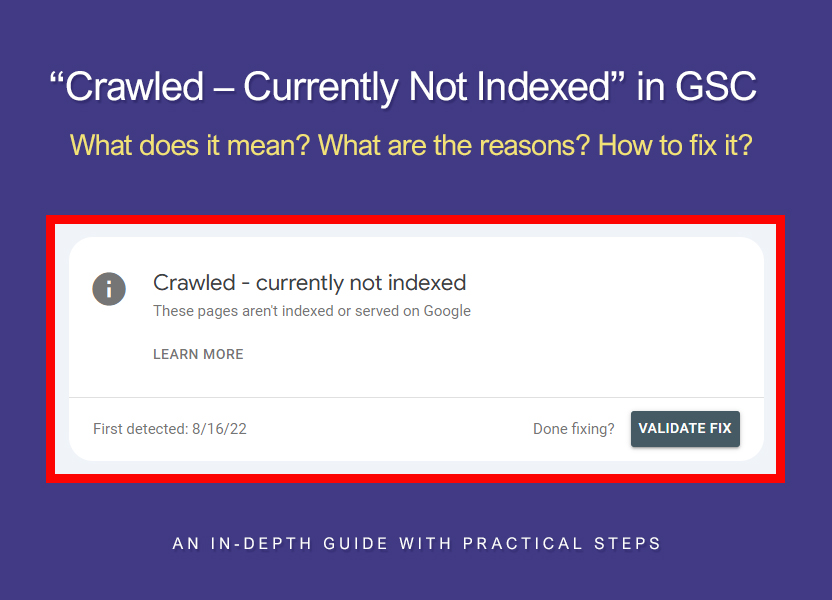
An early sign of likely future penalties is mass deindexing of pages, with the number of deindexed pages increasing over time, and those pages receiving the “Crawled, currently not indexed” status in Google Search Console.
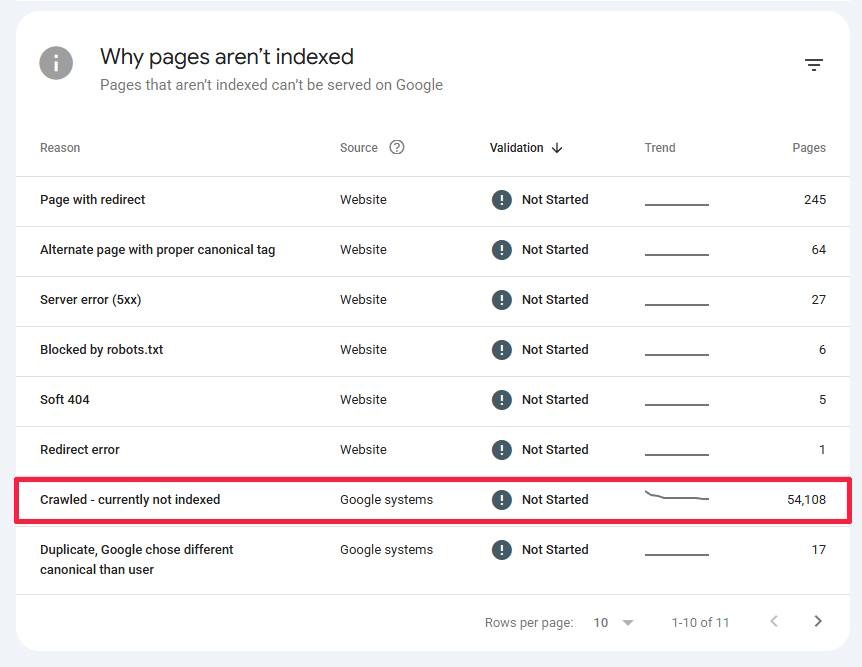
Crawled currently not indexed page in GSC

I covered this in detail in my article, “What is ‘Crawled, currently not indexed’, how to fix it, and why can it be an early warning sign of issues with your site?

Not every website with a large number of deindexed pages showing the “Crawled, currently not indexed” status will be penalized in the future, but every website that has already received a Google “Scaled content abuse” penalty has a large number of unindexed pages with this status. If the percentage of these deindexed pages becomes significant, an algorithmic demotion can be triggered through the unhelpful content classifier, a site-wide signal that has been integrated into Google’s Core algorithm since March 2024. In some cases, a manual action may be imposed, with “Scaled content abuse” indicated in GSC. This can result in either partial or site-wide deindexing of the website.

Recovering the Site

To recover from a manual penalty, you need to conduct a content audit, remove or rewrite the problematic pages, and make the content more original through genuine expert review. After that, you need to submit a Reconsideration Request with examples of the low-quality content that was removed and examples of the high-quality content that was added. The review of the request usually takes anywhere from a couple of weeks to several months.

In the case of an algorithmic demotion, when there is no indication of a penalty in GSC, submitting a Reconsideration Request is not possible. The content needs to be thoroughly reworked, usually with the involvement of experts, the addition of first-hand data, and the removal of pages that have no realistic chance of being improved. After that, you need to wait for the next Google Core Update for the site to be reevaluated.

If not all pages have been cleaned up or the work has not been carried out to the required standard, the penalty will not be removed during the next Core Update. In that case, you will have to wait for the next update, which can take a significant amount of time.

For this reason, the work of correcting the content should be carried out carefully. Otherwise, fully recovering a website can take not months, but years.

Reason #2 - Mass Scaling of Content Across an Entire Niche

This mistake is often made at the same time as the previous one. Once website owners or content managers realize what AI can do, allowing them to produce large amounts of content at virtually no cost and almost instantly, they conclude that they can use it to create thousands of new pages and, as a result, capture large amounts of search traffic.

As a result, the website publishes dozens or even hundreds of pages per week with the goal of covering the entire search landscape of the niche, including low- and micro-volume queries. A separate article page is created for each keyword. The content is almost always AI-generated and templated, with identical header layouts and, as a rule, FAQ sections. The owner’s goal is simple – maximize search traffic through programmatic or scaled AI production. This is a typical strategy for Amazon affiliate projects and other affiliate networks, review websites, and SEO content farms built for traffic arbitrage.

Unlike Reason #1, the primary trigger here is the volume of content and the intent to manipulate search results through scale, rather than simply the quality of the individual pages themselves.

In some cases, we have noticed that websites that have covered most of the queries in their niche move on to creating pages for other adjacent niches that have no direct relevance to their primary niche.

For example, a luxury-focused website starts publishing articles about celebrities without any actual focus on luxury. The reason is simple – celebrity-related queries generate significantly more search traffic than traditional luxury queries. This can increase the website’s traffic several times over within a relatively short period. The traffic graphs look impressive. But then another Google Core or Spam Update rolls out, and the show is over.

How the Site Is Penalized

Before the site is penalized, the number of deindexed pages in GSC begins to increase, with pages receiving the “Discovered – currently not indexed” and “Crawled – currently not indexed” statuses. This usually happens at the same time as the overall number of URLs increases.

The most common form of penalty is an algorithmic penalty triggered when another Google Core or Spam Update is released. No penalty notification appears in GSC, and traffic declines across the entire domain, including pages that were originally high quality, due to a site-wide quality signal.

Typically, about 4 to 8 months pass between the start of large-scale content production and the algorithm’s response. Websites with this type of violation can lose 50% to 90% of their organic traffic within 1 to 2 weeks. Examples include the mass penalties affecting websites in March 2024 and March 2026.

A less common form of penalty is a manual action with “Scaled content abuse” indicated in GSC. This is more characteristic of aggressive and genuinely large-scale AI generation of pages.

Recovering the Site

In the case of an algorithmic demotion, a large-scale review and subsequent cleanup of the pages is required. In many cases, 60% to 90% of the pages have to be removed. This is followed by publishing new, high-quality content based on the revised approach. After that, the site must wait for a new Google Core or Spam Update. Google, of course, provides no guarantee of recovery.

In the case of a manual action, the site needs to be segmented by directories and templates, low-quality content pages need to be removed, and the remaining pages need to be substantially improved with expert review.

Reconsideration Request should then be submitted with a clear description of which pages were removed, how many pages were retained, and how the publication workflow was changed.

A common mistake when submitting reconsideration requests is using vague statements with no specifics about what exactly was fixed and how it was fixed. Typical examples of statements that Google rejects immediately include:

“We improved the quality of the content on our website.”

“We worked on the website and fixed all violations.”

“We will not violate the rules again.”

“Our website now complies with Google’s policies.”

These requests are rejected immediately, without an in-depth review of the website, because the reviewer sees no evidence of actual work having been done – only your claim that it was.

Reason #3 - Systematic Purchase of Low-Quality Backlinks Through SEO Marketplaces and Services

Quality and safe link building has always been a challenging task in SEO. Some webmasters prefer not to deal with it and instead buy cheap links in bulk through SEO marketplaces and link-selling platforms such as Fiverr, Kwork, GoGetLinks, and others.

They typically purchase cheap guest-post packages on PBN networks, comment links, profile links, and bulk link placements on dropped domains. At the same time, the linking sites are often hosted on the same C-class subnets, share a common Whois footprint, use identical CMS templates, cross-link with one another, and follow similar publishing patterns.

The anchor profile is also often heavily skewed toward exact-match commercial queries instead of a natural distribution of anchors, including branded anchors, URL anchors, and generic phrases.

Google is very good at distinguishing natural links, meaning links that appeared on their own without your direct involvement, from purchased and spam links. For this purpose, Google uses SpamBrain, an ML system that has been applied to link profile analysis since December 2022 as part of the Link Spam Update.

This system analyzes link velocity, anchor distribution, donor-domain footprints, and cross-linking patterns. In other words, buying a mass package of cheap links from a popular SEO service, alongside thousands of other buyers doing exactly the same thing, and expecting to remain undetected by Google is simply impossible.

If you are lucky, Google will simply ignore these suspicious backlinks. But that is not always what happens.

What Kind of Penalty Can Occur

In most cases, SpamBrain devalues the links without any notification in GSC. The links stop passing value, but no actual penalty is imposed. The site loses rankings for queries where those links were the primary ranking signal. No links means no rankings.

For non-specialists, this can look like a traffic collapse caused by an algorithmic penalty. In reality, however, no penalty has been applied to the site in these situations. This is a classic redistribution of search results, where some websites are evaluated without taking their unnatural backlinks into account.

However, manual penalties are also not uncommon. These are actual penalties accompanied by a notification in GSC under Manual Actions stating “Unnatural links to your site.” If these spam links were built systematically and in large quantities, the penalty will be site-wide, meaning it will affect all pages of the website:
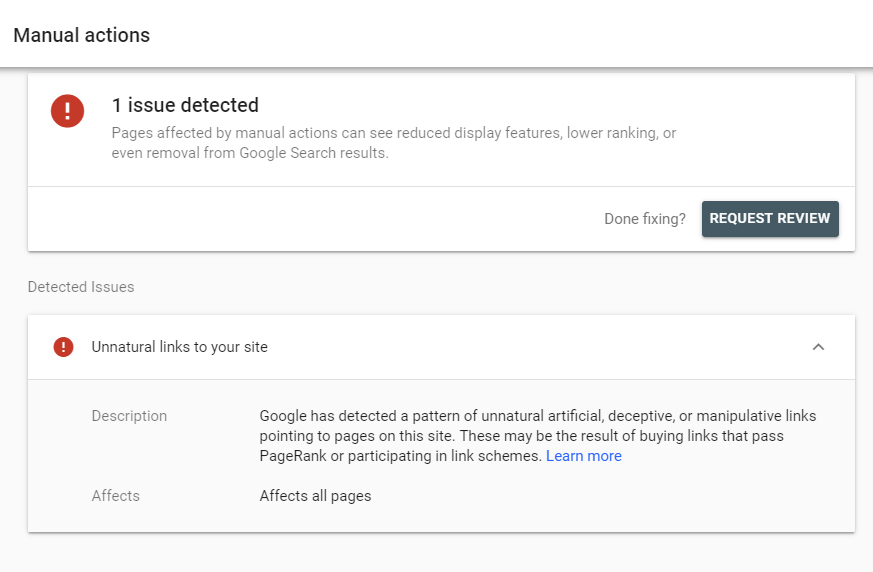
Unnatural links to your site report GSC

Check out our case study – How We Recovered an Affiliate Website After Receiving a Penalty for Unnatural Links.

Sometimes, a penalty for unnatural links is applied only to specific sections of a website. In that case, the remaining pages do not experience a decline in rankings. However, this scenario is much less common.

Recovering the Site

In the case of a manual penalty, you need to audit the link profile and try to remove as many spam links as possible through outreach to the owners of the linking websites.

The remaining spam links should be added to a disavow file through GSC, followed by a Reconsideration Request with a detailed description of the work that was completed, including what was found, what was removed, what was added to the disavow file, and what changes were made to the overall link-building strategy.

As with content-related penalties, it is important to clearly demonstrate that you have done substantial work to clean up your link profile.

At the same time, you should be prepared for the first few Reconsideration Requests to be rejected. This is a common situation, especially when the link profile cleanup has not been completed thoroughly.

Based on our experience, you will typically need to submit between 2 and 5 Reconsideration Requests before this type of penalty is removed.

Accordingly, the review process can take anywhere from several weeks, which is rare, to several months. In addition, it may take another 3 to 6 months to fully recover the rankings the site had before the penalty.

In the case of algorithmic link devaluation, you do not necessarily need to submit the spam links to a disavow file through GSC. Instead, you can focus on physically removing the spam links and, of course, on white-hat link-building methods and attracting natural links to link-magnet pages. Then, as always, you need to wait for the next Spam Update or Core Update for reevaluation.

Reason #4 - Low Content Helpfulness or Content Created for Algorithms

This is one of the most difficult cases to recover from. This issue typically involves filling a website with pages that are relevant to the query and often contain unique text, but are written with the search algorithm in mind rather than the actual user.

Such pages often have clickbait, SEO-optimized titles. At the same time, the promises made in the title and H1 are not fulfilled in the article itself. The answer to the main question is delayed until the middle or end of the article under the pretext that “the introductory SEO text with keywords comes first.” The text itself is padded for the sake of length, practical details and first-hand experience are missing, and the structure is built around SEO patterns. Pages contain artificial H2s targeting LSI keywords, as well as FAQ blocks created for People Also Ask without any real user questions behind them.

There may be no actual keyword overuse at all. But the content itself was not created for the reader, who, by the way, will most likely close the page after reading the first few paragraphs.

Unlike Reason #1, where the content is simply paraphrased content, most often AI-generated, taken from other sources without depth or an author’s own perspective, this issue is characterized by content created specifically to make the page rank while making it difficult for the reader to get an answer to their intent.

In practice, these two issues often occur together, but they are diagnosed separately. Google evaluates this type of content through the people-first vs. search-first framework described in Helpful Content guidance. The Unhelpful Content Classifier works as a site-wide signal, applying an overall assessment to all pages. As a result, even high-quality pages can lose rankings and traffic when the overall share of unhelpful content on the site is high.

What Kind of Penalty Is Applied

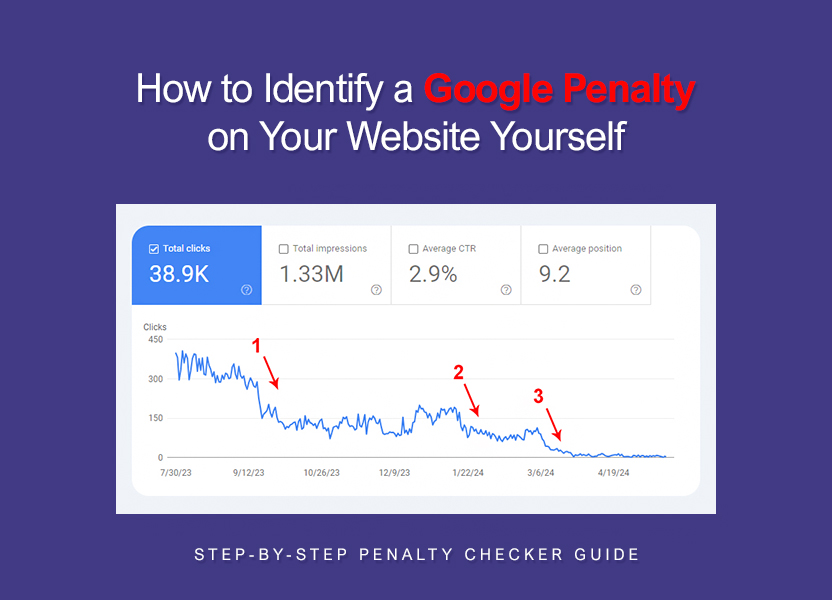
The penalty is exclusively an algorithmic demotion through the Unhelpful Content Classifier. With this demotion, traffic does not drop sharply the way it typically does with a Scaled Content Abuse penalty – instead, it declines gradually, step by step, month after month, until it falls to a handful of visits:
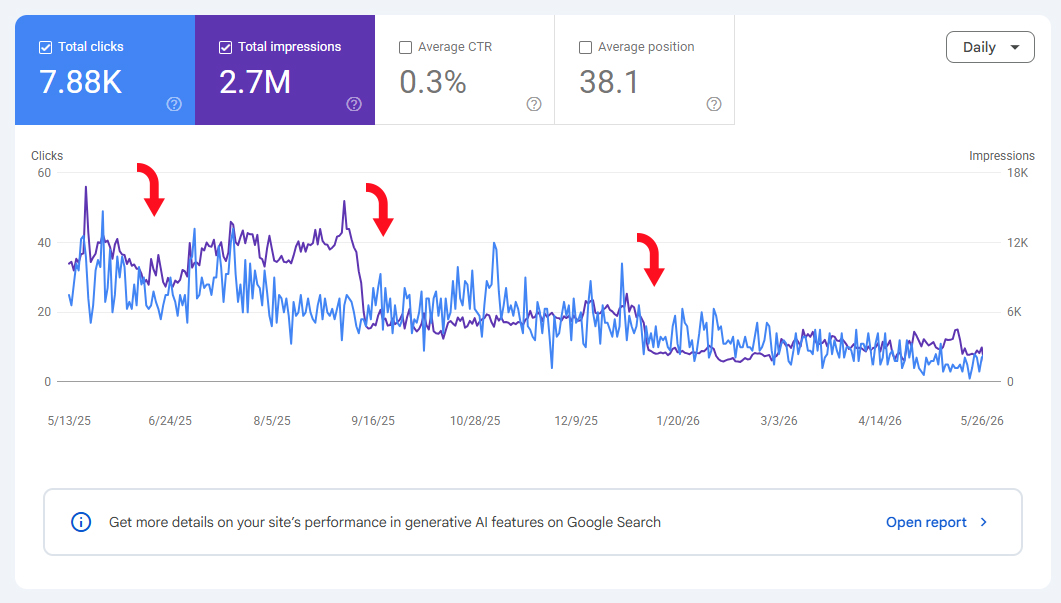
Helpful Content Update Google penalty

Since March 2024, the system has been integrated into the Google Core algorithm, and a separate “Helpful Content Update” no longer exists as an event.

Manual action is not issued separately for this specific violation, so there will be no penalty notification for your site in GSC. Its effects can sometimes overlap with Scaled Content Abuse, but that is a different system that requires different recovery methods.

Recovering the Site

Recovering websites affected by unhelpful content is one of the most difficult cases in SEO. This requires a deep audit of the site’s pages to identify those with unhelpful or insufficiently useful content.

The editorial approach itself needs to be genuinely reworked, with a focus on people-first content, removal of useless material, moving the main answer closer to the beginning, and adding first-hand experience and practical details.

It is also essential to remove empty pages that provide no value and have poor SEO prospects. For example, pages targeting high-volume queries where gaining traffic is almost impossible because of extremely high competition.

Reevaluation takes place only during Google Core Updates, which occur approximately 3 to 4 times a year. Recovery can begin no earlier than 6 months after the work has been completed and, unfortunately, there is no upper time limit, as recovery can take years.

For example, websites affected by the infamous Helpful Content Update in September 2023 and March 2024 had still not achieved full recovery even after several consecutive Core Updates.

Reason #5 - Excessive Advertising Banners and Pop-Ups

This issue is characteristic of content websites with aggressive monetization through advertising banners and intrusive advertising pop-ups. Notably, we have observed cases where penalized websites had excellent content written by professional journalists and authors who were thought leaders in their respective niches. These sites were well-known online magazines and popular blogs, and yet they were still penalized by Google.

The reason lies in the excessive amount of advertising that interferes with access to the main content. This primarily includes full-screen pop-ups that appear immediately when a user arrives from search, sticky banners that occupy a large portion of the screen on mobile devices, ads placed above the main content (top-heavy layout), autoplaying videos, interstitials that require the user to close them before accessing the article, and other aggressive advertising formats.
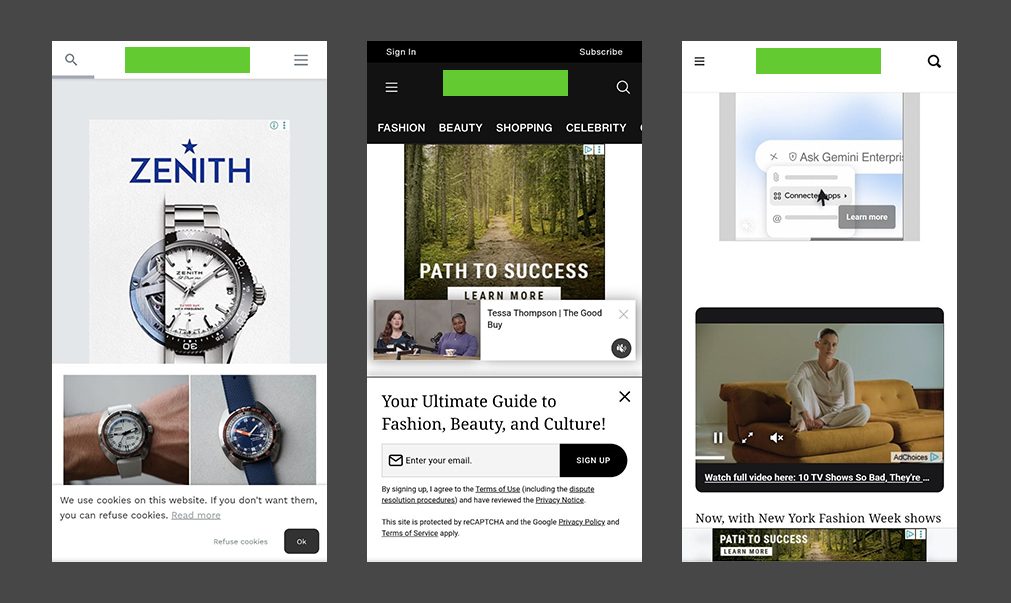
Excessive Advertising Banners and Pop-Ups

Google detects this through several signals confirmed in the 2024 Content Warehouse leak:

violatesMobileInterstitialPolicy – a signal indicating a violation of the mobile interstitial policy.

clutterScore – a site-level signal measuring how cluttered a site is with advertising and elements outside the main content.

Page Experience signals – Core Web Vitals (LCP, INP, CLS), mobile-friendliness, HTTPS, and the absence of intrusive interstitials.

Using these signals, Google evaluates an ad based on how much it interferes with the user’s ability to access the content. In our experience, a banner should occupy no more than 15% of the screen area on a mobile device. At this size, the user can still see most of the content with the banner open and can read the page comfortably.

Google has not officially published an exact figure and uses the wording “reasonable amount of screen space,” but practical experience shows that 15% is the threshold beyond which ranking problems may begin.

In addition to size, several other technical factors are critical. The banner should have a clearly visible and easily clickable close button, without microscopic X icons in the corner or hidden elements. The banner should not automatically appear immediately after the page loads, covering content that the user has already started reading. Sticky banners attached to the top or bottom of the screen are acceptable as long as they do not expand to cover half the screen while the user scrolls.

What Kind of Penalty Is Applied

The penalty is exclusively algorithmic. A manual action is not issued for aggressive advertising.

At the same time, the penalty is applied only to the page that the user opened after clicking through from the search results. In other words, interstitials that appear during navigation within the site are not taken into account and are technically safe.

However, I still do not recommend using them, because we do not know the exact number of user visits from search that is sufficient to activate a penalty for a specific page. And since almost all pages on large content websites receive some amount of search traffic, this creates certain risks for all pages on the site.

Since 2021, Google has fully switched to mobile-first indexing. This means that the mobile version of a page is used for ranking even for desktop searches. Therefore, if your site displays aggressive interstitials only on mobile while the desktop version is clean, the penalty will still apply to both versions. – Google considers the mobile version to be the primary version.

Recovering the Site

All large pop-ups that cover a significant portion of the screen should be removed from the site. This should be checked in the mobile view. This is the first and most important step.

Limit the size of overlays to 15% of the screen. This applies to any pop-up elements placed over the content, including modals, promotional banners, and subscription forms.

What is important is that the total area of all active overlays at the same time is taken into account, even if each individual element looks compact on its own.

When a user arrives from search, they should immediately see the article rather than having to close elements that are covering it.

There is no need to wait for the next Core Update. The signal is reevaluated automatically during the next crawl of the affected pages. However, I recommend speeding up the process by submitting the pages for reindexing through GSC.

Recovery can take anywhere from a couple of weeks to several months. However, it is usually faster than recovery from content-related penalties because this is a technical signal that is reevaluated at the individual page level.

These are only a small portion of the possible reasons that can lead to lower rankings and loss of traffic. Other issues include hidden content manipulation aimed at search engines, website hacks involving the injection of spam content, manipulative Schema.org markup, manipulation of content update dates, keyword stuffing, and others.

If you are seeing an unexplained decline in organic traffic to your website and are having difficulty identifying the cause yourself, contact our agency. We can help you not only identify the actual causes of potential penalties, but also explain how to correct them properly in order to restore your traffic.

Facebook
Twitter
Email
Picture of Ivan Bogovik
Ivan Bogovik

Ivan Bogovik is the founder of RecoveryForge, an SEO agency focused on penalty recovery. With over 16 years in the SEO field, Ivan has extensive experience helping websites recover from Google penalties like Penguin, Panda, and other algorithmic updates. Since 2014, he has successfully guided many websites back to health and regularly shares his insights at SEO events and webinars.

Newsletter

Sign up for our newsletter to be one of the first to receive the latest SEO tips and tricks.

Ready to get rid of your penalty?

Let us know about your issue and we will do everything we can to help your website recover its traffic. Fill out the form at the top of our website and send your inquiry. Our specialists will then get in touch with you.

Do you have any questions?
Not sure what to do?

Don’t worry, just tell us your situation. Ask your questions, and we will provide you with comprehensive answers.